

Tecnoprism Launches Automation COE Platform for Enterprises to Scale their Automation Strategy
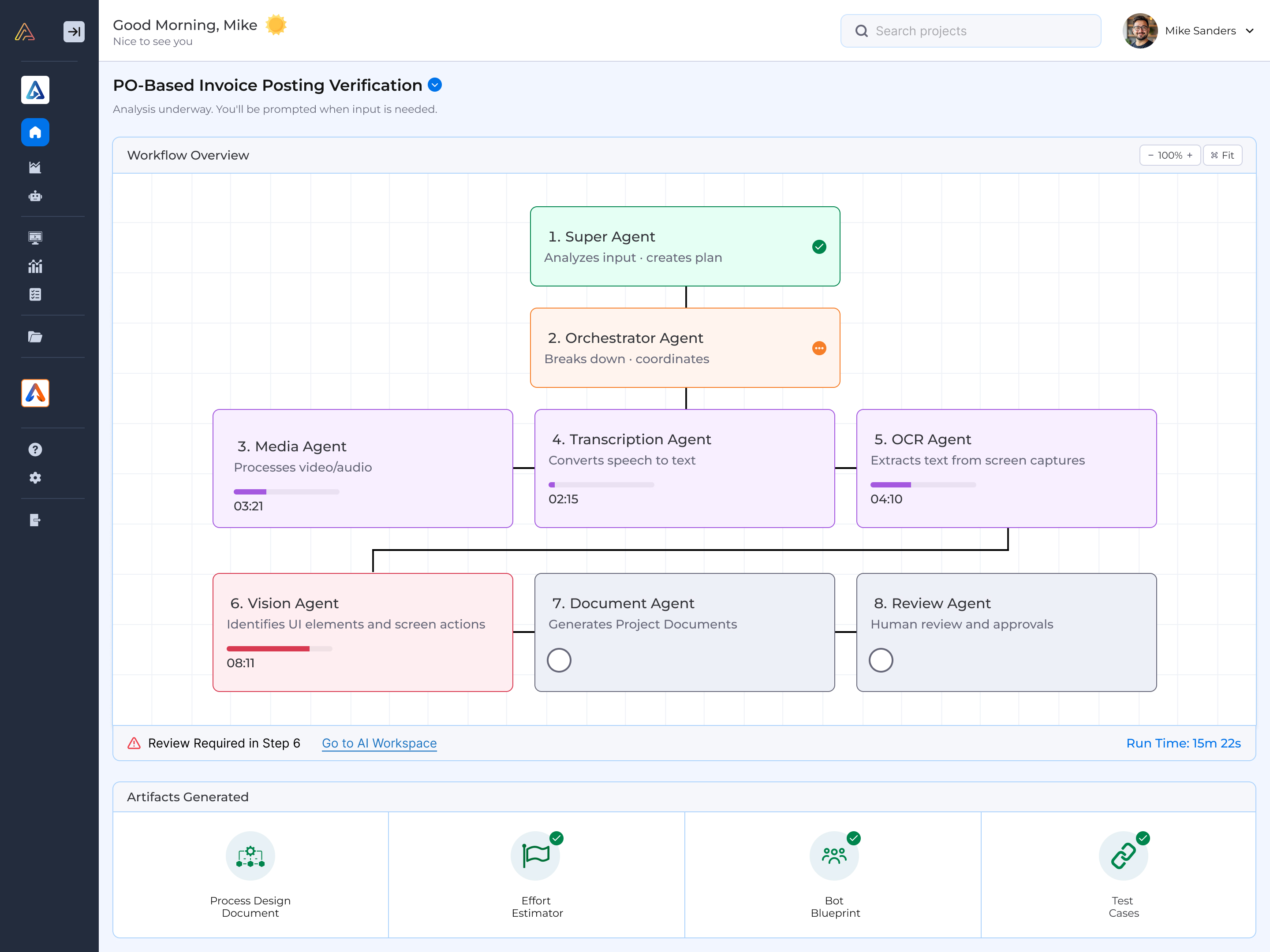
Experience ARIA for 92% faster PDD
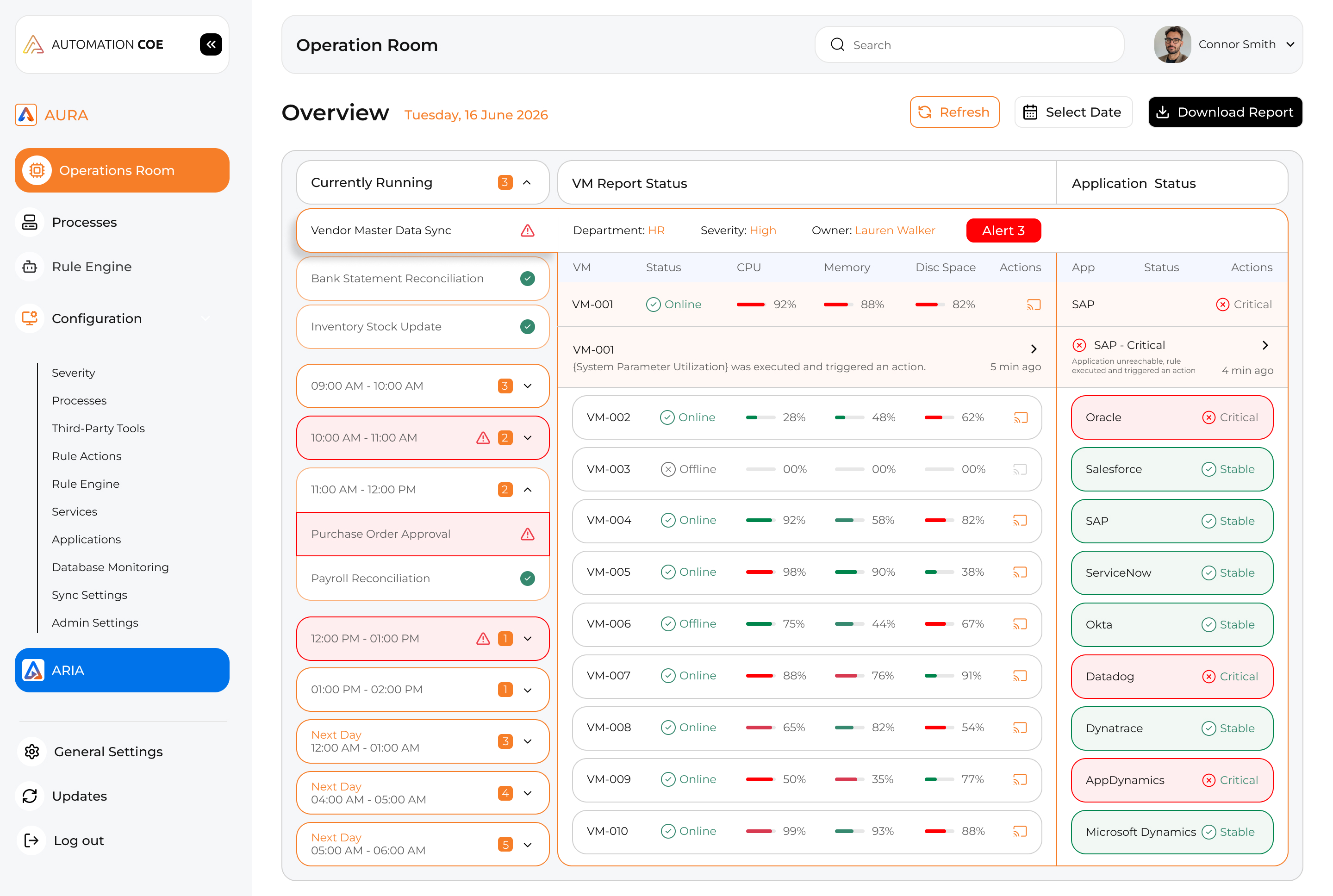
AURA unifies monitoring, health analysis, alerting, and operational intelligence
Connects AI-driven process discovery with proactive runtime assurance to reduce costs, improve reliability and accelerate automation outcomes at scale.
Automation adoption has accelerated rapidly, with nearly 70% of organizations already implementing it in at least one business function. Yet the outcomes have been inconsistent. Gartner estimates that up to 30% of automation initiatives fail to deliver expected results, often due to poor process understanding and governance gaps.
At scale, these inefficiencies translate directly into financial impact. Enterprises continue to spend significant time on manual process discovery, relying on workshops and documentation cycles that lead to incomplete capture and downstream rework. In parallel, runtime failures tied to infrastructure instability, application latency, or dependency breakdowns remain a persistent challenge. Industry research shows that over 90% of enterprises report downtime costs exceeding $300,000 per hour, with many exceeding $1 million per hour. Meanwhile, 98% of organizations report automation-related issues contributing to SLA breaches, highlighting the operational risk of reactive systems.
“Automation is no longer limited by what it can execute, but by how well it understands processes and how reliably it operates in dynamic environments,” said Tapan Patel, Co-Founder of Tecnoprism. “At scale, these gaps increase total cost of ownership and delay time to value. What enterprises need now is not more automation, but better automation systems.”
Tecnoprism’s Automation COE is built around that shift. It connects two critical layers of the automation lifecycle, discovery and runtime, into a continuous system designed to improve both speed and reliability.
At the discovery layer, ARIA (Automation Requirements Intelligence Agent) replaces manual interpretation with direct process understanding. By analysing recorded workflows, ARIA captures actions, decision points and variations to generate structured outputs required for automation. Traditional discovery methods often miss real-world process complexity, limiting outcomes and driving rework. By contrast, automated approaches can compress discovery timelines by as much as 90% while improving accuracy, fundamentally changing how quickly automation can move from idea to execution.
At the operational layer, AURA (Automated Uptime and Runtime Assurance) addresses a different challenge, reliability at scale. As automation environments grow more interconnected, even minor disruptions can cascade across systems. In a financial services operations environment, for example, a delay in a dependent application can stall multiple automated processes, resulting in transaction backlogs, SLA breaches and costly manual intervention. In such scenarios, even short outages can translate into significant financial impact, with downtime costs ranging from hundreds of thousands to millions of dollars per hour.
AURA introduces a proactive approach by validating system readiness before execution and continuously monitoring runtime behaviour to detect risks before failure occurs. This shifts operations from reactive recovery to predictive stability; a critical requirement as automation becomes business-critical.
By bringing ARIA and AURA together, Automation COE connects ‘how processes are understood’ with ‘how automation performs’ in real environments. This creates a continuous feedback loop, where better discovery improves execution, and runtime insights refine future automation decisions.
For enterprises, the impact is not incremental, it is economic. Reducing manual discovery effort, minimizing rework, and preventing runtime failures directly improves both speed and cost efficiency. Tecnoprism estimates that integrated approaches like Automation COE can reduce overall automation lifecycle costs by 30% to 45%, while accelerating time to value and improving return on automation investments.
As organizations move toward more intelligent and autonomous systems, the challenge is no longer deploying automation, but ensuring it can scale without introducing hidden cost and risk. Automation COE is positioned to address that shift, enabling automation to operate with greater clarity, control and resilience.
Automation COE is now available to enterprise customers.
About Tecnoprism
Tecnoprism is a pure play AI and automation company focused on helping enterprises build intelligent, scalable operations. Founded by industry pioneers with more than three decades of combined automation experience, Tecnoprism brings deep intelligence, extensive experience and enterprise scale execution to global business operations.
Backed by a team of 250+ AI and automation engineers and a global presence across North America, MENA, Southeast Asia, and APAC, Tecnoprism partners with enterprises and Fortune 500 companies enabling them to move beyond isolated automation toward adaptive, outcome-driven systems.
Shashank Jha
Tecnoprism
+91 63529 37828
email us here
Visit us on social media:
LinkedIn
X
Legal Disclaimer:
EIN Presswire provides this news content "as is" without warranty of any kind. We do not accept any responsibility or liability for the accuracy, content, images, videos, licenses, completeness, legality, or reliability of the information contained in this article. If you have any complaints or copyright issues related to this article, kindly contact the author above.
