

Regenerative Agriculture Market Size to Surpass USD 72.21 Bn by 2034
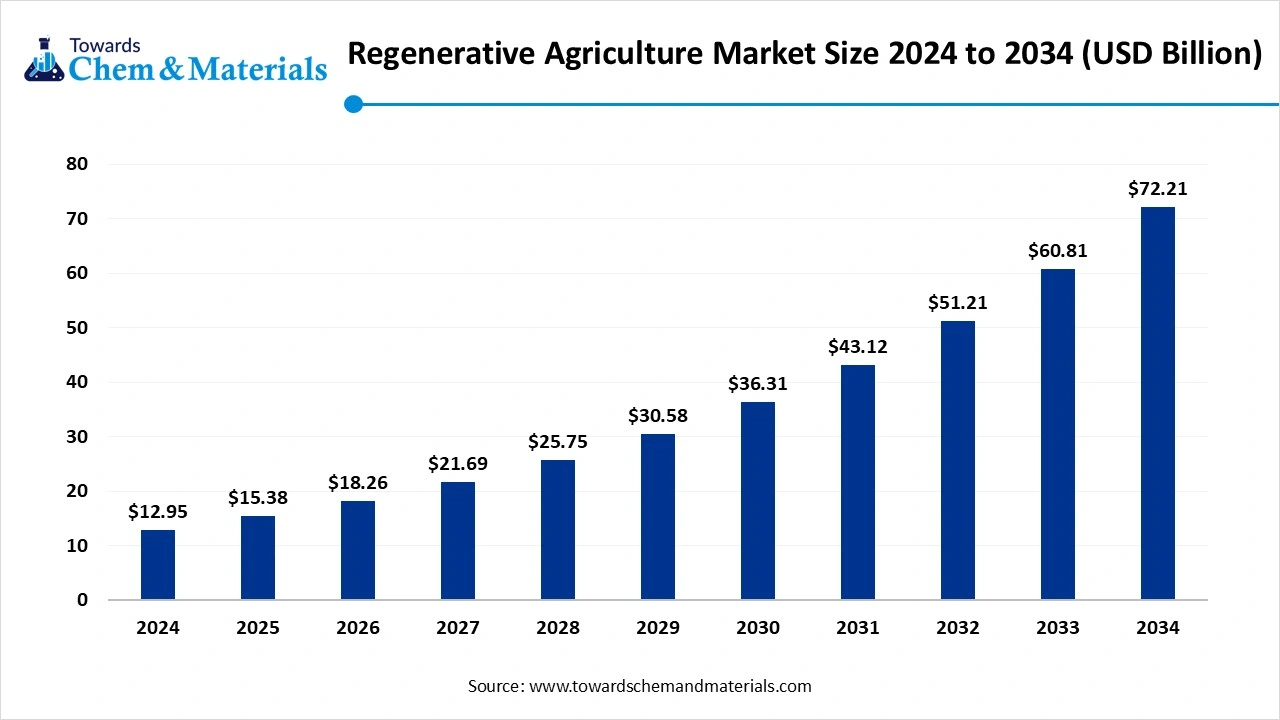
According to Towards Chemical and Materials, the global regenerative agriculture market size is calculated at USD 15.38 billion in 2025 and is expected to surpass around USD 72.21 billion by 2034, growing at a compound annual growth rate (CAGR) of 18.75% over the forecast period 2025 to 2034.
Ottawa, Oct. 10, 2025 (GLOBE NEWSWIRE) -- The global regenerative agriculture market size was valued at USD 12.95 billion in 2024 and is anticipated to reach around USD 72.21 billion by 2034, growing at a compound annual growth rate (CAGR) of 18.75% over the forecast period from 2025 to 2034. A study published by Towards Chemical and Materials a sister firm of Precedence Research.
The Rising consumer demand for sustainable and organic food products is driving the growth of the market.
Download a Sample Report Here@ https://www.towardschemandmaterials.com/download-sample/5900
Regenerative Agriculture Overview
The regenerative agriculture market is emerging as a transformative approach to sustainable food production, focusing on rebuilding soil health, enhancing biodiversity, improving water cycles, and increasing ecosystem resilience. Unlike conventional agricultural systems that rely heavily on chemical inputs and monocultures, regenerative practices emphasize soil regeneration through techniques such as crop rotation, cover cropping, reduced tillage, and integration of livestock. This market’s growth is being fuelled by rising consumer awareness of environmentally friendly and organic products, government incentives promoting sustainable farming, and corporate commitments to carbon reduction and supply chain transparency.
Goals of regenerative agriculture
- Produce enough nutritious food for the world’s population
- Help mitigate climate change by sequestering carbon in soil and reducing greenhouse gas emissions
- Restore threatened biodiversity and enhance natural habitats
- Prevent further deforestation and grassland conversion by increasing productivity on existing farmland
- Enhance farmer livelihoods.
Regenerative Agriculture Market Report Highlights
- The North America regenerative agriculture market size was estimated at USD 3.89 billion in 2024 and is projected to reach USD 21.71 billion by 2034, growing at a CAGR of 18.76% from 2025 to 2034.
- By region, North America dominated the regenerative agriculture market with approximately 30% industry share in 2024.
- By practice type, the soil management segment led the market with approximately 35% industry share in 2024.
- By products/ manufactured inputs, the fertilizers & soil amendments segment emerged as the top-performing segment in the market with approximately 30% of the industry share in 2024.
- By technology/ tools type, the data platforms & analytics tools segment led the market with approximately 40% share in 2024.
- By services and business model, the advisory & agronomic consulting segment led the regenerative agriculture market with approximately 30% industry share in 2024.
- By crop/ production type, the raw crops segment emerged as the top-performing segment in the market with approximately 40% of the industry share in 2024.
- By end-use industry, the food and beverage segment led the market with approximately 45% share in 2024.
Buy Now this Premium Research Report at a Special Price Against the List Price With [Express Delivery] @ https://www.towardschemandmaterials.com/checkout/5900
Regenerative Agriculture Market Report Scope
| Report Attribute | Details |
| Market size value in 2026 | USD 18.26 billion |
| Revenue forecast in 2034 | USD 72.21 billion |
| Growth rate | CAGR of 18.75% from 2025 to 2034 |
| Actual data | 2021 - 2024 |
| Forecast period | 2025 - 2034 |
| Segments covered | By Practice Type, By Products / Manufactured Inputs, By Technology & Tools, By Services & Business Models, By Crop / Production Type, By End-Use Industry, By Region |
| Regional scope | North America; Europe; Asia Pacific; Latin America; MEA |
| Country scope | U.S.; Canada; Mexico; UK; Germany; France; China; India; Japan; Australia; South Korea; Brazil; UAE; Saudi Arabia; South Africa |
| Key companies profiled | Great Plains Manufacturing, Inc., Kverneland Group AS , Horsch Maschinen GmbH , Amazone GmbH & Co. KG , Vermeer Corporation , Corteva Agriscience , Bayer CropScience , Syngenta Group , BASF Agricultural Solutions, Novozymes A/S , Marrone Bio Innovations, Inc. , Koppert Biological Systems , Verdesian Life Sciences, LLC , The Andersons, Inc. , Pacific Biochar Solutions , Heliae Development, LLC |
For more information, visit the Towards Chemical and Materials website or email the team at sales@towardschemandmaterials.com| +1 804 441 9344
Regenerative agriculture: A sustainable solution
The agricultural industry is turning to regenerative agriculture practices in response to mounting environmental challenges. This approach emphasizes sustainable practices originating from traditional farming methods and restoring and maintaining soil health while promoting ecological balance. Although there is no universal definition or standardized practices for regenerative agriculture, most initiatives align around four core principles:
- Minimize soil disturbance: Reducing physical, biological, and chemical disruptions to preserve natural soil processes.
- Maximize crop diversity: Implementing crop rotation and diverse planting strategies to enhance ecosystem resilience.
- Maximize soil coverage with living roots: Using cover crops to protect and restore soil composition.
- Maximize livestock integration: Incorporating plant residues and manure as natural fertilizers and promoting rotational grazing to improve soil fertility.
The benefits of regenerative agriculture
Regenerative agriculture offers a pathway to mitigate the environmental impacts of farming while enhancing productivity. Its benefits include:
- Climate action: Mitigates GHG emissions and promotes carbon sequestration in soil.
- Soil health restoration: Replenishes soil fertility and productivity.
- Resource efficiency: Optimizes the use of land and water resources.
- Biodiversity recovery: Increases soil biodiversity, enhancing resilience to pests and climate variability.
-
Improved farm efficiency: Boosts productivity while reducing dependence on synthetic inputs.
A Global Shift to Regenerative Agriculture Can:
- Feed the world: Small farmers already feed the world with less than a quarter of all farmland.
- Decrease GHG emissions: A new food system could be a key driver of solutions to climate change. The current industrial food system is responsible for 44 to 57% of all global greenhouse gas emissions.
- Reverse climate change: Emissions reduction alone is simply inadequate. Luckily, the science says that we can actually reverse climate change by increasing soil carbon stocks.
- Improve yields: In cases of extreme weather and climate change, yields on organic farms are significantly higher than conventional farms.
- Create drought-resistant soil: The addition of organic matter to the soil increases the water holding capacity of the soil. Regenerative organic agriculture builds soil organic matter.
- Revitalize local economies: Family farming represents an opportunity to boost local economies.
- Preserve traditional knowledge: Understanding indigenous farming systems reveals important ecological clues for the development of regenerative organic agricultural systems.
- Nurture biodiversity: Biodiversity is fundamental to agricultural production and food security, as well as a valuable ingredient of environmental conservation.
- Restore grasslands: One third of the earth's surface is grasslands, 70% of which have been degraded. We can restore them using holistic planned grazing.
- Improve nutrition: Nutritionists now increasingly insist on the need for more diverse agro-ecosystems, in order to ensure a more diversified nutrient output of the farming systems.
A strategic Approach to Regenerative Agriculture implementation
Implementing regenerative agriculture requires a strategic approach tailored to specific climates, soil types and current quality, crop types, and farming systems. Decision-makers must address three core questions:
- Where? Identify regions based on climate risks, regulatory frameworks, and local community roles.
- What? Define the focus of the scheme, including crop-specific needs, land access, and input provision.
-
How? Outline the business model, detailing financing mechanisms, stakeholder collaboration, and legal structures.
By addressing these questions, stakeholders can develop comprehensive solutions that create sustainable value for all regenerative agriculture value chain participants.
Regenerative agriculture is more than a farming method; it’s a paradigm shift. By investing in tailored strategies, addressing farmer challenges, and fostering collaboration, regenerative agriculture has the potential to transform global agriculture into a system that feeds the world while healing the planet.
What Are the Major Trends in The Regenerative Agriculture Market?
- Rapid expansion of soil first and soil health focused practices such as cover cropping reduced tillage, and composting as foundational elements.
- Growing adoption of technology platforms and tools for monitoring, verification, and decision making, including data analysis, remote sensing, and satellite/drone-based systems.
- Rising interest in carbon project development and crediting, making carbon sequestration and ecosystem service payments part of farmers revenue models.
- Increasing demand for biological inputs and bio stimulants over synthetic fertilizers, as farmers focus on rebuilding soil biology and reducing chemical dependencies.
How Does AI Influence The Growth Of The Regenerative Agriculture Market In 2025?
In 2025, AI is reshaping regenerative agriculture by acting as a powerful enabler that turns ecological goals into actionable farming strategies machine learning models and predictive analytics synthesize data from soil sensors, drones, weather stations and field histories to guide farmers on when and where to plant cover crops, adjust inputs, or optimize grazing cycles. AI powered soil carbon co-pilots can monitor changes in organic carbon levels over time, reducing reliance on costly and laborious physical sampling while offering real time insights that support carbon credit schemes and sustainability reporting. Decision support systems informed by AI help farmers adopt regenerative techniques faster and with greater confidence mitigating risks associated with transition and making regenerative methods economically viable in more environments.
Regenerative Agriculture Market Dynamics
Growth Factors
Can AI Tailor Regenerative Practices For Each Farm?
AI is enabling hyper localized farm guidance by analysing data from satellites, sensor, weather models, and field history to issue customized recommendations on cover cropping, crop rotation, and input reduction. This kind of decision support helps farmers adopt regenerative methods with less risk and confusion, smoothing their transition to more resilient systems.
Will Carbon Markets Pull More Farmers Into Regenerative Models?
As carbon credit programs begin valuing verified soil carbon sequestration, farmers, adopting regenerative practices gain an extra revenue stream, which motivates more widespread adoption in response to climate and sustainability goals. This financial incentive, backed by measurement technologies and corporate interest in offset strengthens the economic case for regenerative farming.
Market Opportunity
Could Carbon Markets Become A Stable Extra Income Source For Farmers?
As firms and asset managers increasingly recognize the role of carbon credits in agriculture, methods to quantify soil carbon sequestration are becoming more robust and accepted. This shift enables farmer’s to monetize regenerative practices via verified credits, improving their income resilience and incentivizing sustainable methods.
Will Smart Tech Unlock Easier Farm Level Adoption?
Advanced data, remote sensing and AI are making it simpler for farmers to monitor soil health, crop diversity, and ecosystems effects, helping reduce risk and uncertainty in transitions. This ease of measurement and automation can drive more widespread adoption of regenerative systems across diverse geographies.
Limitations In The Regenerative Agriculture Market
- Lack of robust standards and verification: there is uncertainty due to inconsistent systems for measuring soil health, biodiversity and carbon sequestration, which makes it hard for stakeholders to trusty claims or compare outcomes across farms.
- High upfront investment and transition costs: moving from conventional to regenerative methods demands investment in new tools, changes in farming practices, training and sometimes short-term yield drops, which discourage many farmers from making the switch.
Regenerative Agriculture Market Segmentation Insights
By Practice Type Insights
Why Did The Soil Management Segment Dominated The Regenerative Agriculture Market?
The soil management segment dominated the market in 2024. This segment focuses on enhancing soil fertility, structure and biological activity through methods such as cover cropping, reduced tillage, and compost application. Farmers are increasingly prioritizing soil management as it directly impacts yields stability, water retention, and carbon sequestration, making it foundational to all regenerative strategies. The adoption of advanced monitoring tools and advisory services further strengthens soil management practices, assuring that both large scale and small farms can implement them effectively. As sustainability and ecosystem restoration become central to agriculture, soil management continues to attract investments and attention, cementing its role as a dominant practice in the regenerative agriculture landscape.
The pest and disease management segment is expected to grow at the fastest rate in the market during the forecast period. This growth reflects an increasing focus on reducing chemical pesticide use while protecting crops through integrated pest management, biological controls, and disease resistant crop varieties. Farmers are adopting innovative solutions that minimize ecological disruption and enhance long term farm resilience. Technology and data analytics play a key role in predicting outbreaks and optimizing interventions, making pest and disease management more precise and effective.
By Product/Manufactured Inputs Insights
Why Did Fertilizers And Soil Amendments Segment Dominated The Regenerative Agriculture Market?
The fertilizers and soil amendments segment dominated the market in 2024. These inputs are crucial for replenishing soil nutrients while supporting sustainable crop growth, and they play a central role in implementing regenerative practices. Farmers are increasingly moving away from synthetic chemicals toward organic or naturally derived amendments that improve soil fertility, water retention, and microbial activity. The segment benefits from rising awareness of sustainable farming and government policies encouraging environmentally friendly inputs. Advisory services and agronomic guidance further help farmers optimize the use of fertilizers and soil amendments, making this segment a dominant contributor to the market’s overall adoption.
The biologicals and bio stimulants segment is projected to experience the highest growth rate in the market during the forecast period. These products support plant growth by enhancing natural biological processes, increasing nutrient uptake, and improving resistance to stress and disease. Growing interest in reducing chemical dependency and promoting ecological sustainability is driving demand for these innovative solutions. Farmers are also leveraging precision application technologies to maximize the effectiveness of biological inputs while minimizing costs. Combined with supportive policies and increasing consumer preference for sustainably produced food, the biologicals and bio stimulants segment represents a high potential growth area in regenerative agriculture.
By Technology/Tools Insights
Why Did Data Platforms And Analytics Tools Segment Dominated The Regenerative Agriculture Market?
The data platforms and analytics tools segment captured the biggest portion of the market in 2024. These technologies allow farmers to monitor soil health, crop performance, and environmental impacts in real time, supporting informed decisions on planting, irrigation, and input management. Integration with AI and machine learning enhances predictive insights, helping implement regenerative practices more efficiently and with higher success rates. Farmers, consultant, and agribusinesses increasingly rely on data analytics to verify outcomes and improve operational sustainability. As technology adoption grows, data platforms continue to play a central role in enabling scalable regenerative agriculture practices.
The precision application hardware segment expects the fastest growth in the market during the forecast period. This equipment allows farmers to apply inputs such as fertilizers, bio stimulants, or water precisely where needed, reducing waste and enhancing soil and crop health. Coupled with monitoring technologies, precision hardware improves efficiency, sustainability, and economic outcomes for farms of all sizes. Growing interest in digital and smart farming solutions is further accelerating the adoption of precision hardware in regenerative agriculture.
By Service And Business Model Insights:
Why Did Advisory and Agronomic Consulting Segment Dominated The Regenerative Agriculture Market?
The advisory and agronomic consulting segment dominated the market in 2024. These services provide critical guidance to farmers on implementing regenerative practices, evaluating soil health, and adopting sustainable inputs. Consultants helps farms transition from conventional methods, assuring that practices like crop rotation, cover cropping, and integrated pest management are tailored to specific conditions.
The carbon project development and crediting segment is set to experience the fastest growth in the market during the forecast period. Framers can now earn additional income by verifying soil carbon sequestration and selling carbon credits, incentives the adoption of regenerative practices. Digital tools and monitoring systems ensure accurate reporting and compliance with standards. Corporate and government interest in carbon neutrality is fuelling demand for such programs, creating opportunities for farmers and service providers alike.
By Crop/ Production Type Insights
Why Did Raw Crops Segment Dominated The Regenerative Agriculture Market?
The raw crops segment maintained a leading position in the market in 2024. Raw crops such as grains, cereals, and pulses from the backbone of regenerative agriculture because they benefit directly from soil management, crop rotation, and reduced chemical inputs. Large scale cultivation of raw crops provides opportunities to demonstrate the impact of regenerative practices on yield, soil fertility, and biodiversity. Farmers are increasingly applying regenerative methods to raw crops to ensure long term soil health and productivity.
The horticulture and vegetables segment is projected to expand rapidly in the market during the forecast period. Farmers are turning to regenerative practices for vegetables and fruits to enhance soil nutrition, improve pest management, and meet the rising demand for sustainable produce. Innovative techniques, including integrated pest management and biological inputs, are increasingly applied to these high value crops. The growing consumer preference for healthy, eco-friendly produce is driving adoption, making this segment a key growth area.
By End Use Industry Insights
Why Did Food And Beverage Segment Dominated The Regenerative Agriculture Market?
The food and beverage segment led the market in 2024. This segment captures demand from consumers seeking sustainably produced and organic products. Companies in this sector are increasingly sourcing ingredients grown under regenerative practices to meet environmental commitments and consumer expectation. The focus on sustainable sourcing drives investment in farms that adopt regenerative methods, supporting broader market growth.
The retail and CPG brands segment is anticipated to grow with the highest CAGR in the market during the forecast period. These companies are increasingly partnering with regenerative farms to secure sustainably produced ingredients for their products. Marketing claims of environmental responsibility carbon reduction are boosting demand for regenerative inputs. Technological and certification frameworks are enabling faster adoption and traceability.
By Regional Insights
Why Is North America Dominating the Regenerative Agriculture Market?
North America dominated the regenerative agriculture market in 2024. This leadership is attributed to several factors, including the region’s strong policy support, significant investments in sustainable farming practices, and the presence of major agribusinesses committed to regenerative methods. The adoption of regenerative practices is further propelled by consumer demand for sustainably produced food and beverages. Additionally, the integration of advanced technologies such as data analytics and precision agriculture tools has enhanced the efficiency and scalability of regenerative farming I North America. These combined efforts position North America as a key player in the global regenerative agriculture landscape.
The United States is a primary driver of innovation in regenerative agriculture. The country’s vast agriculture landscape, coupled with supportive federal and state policies, has facilitated the widespread adoption of regenerative practices. U.S. farmers are increasingly implementing techniques such as cover cropping, reduced tillage, and integrated livestock systems to improve soil health and biodiversity.
Asia Pacific Regenerative Agriculture Market analysis
The Asia Pacific regenerative agriculture industry is expected to be the fastest growing segment, with a CAGR of 28% over the forecast period. The rise of conscious consumerism and domestic markets for sustainable food is beginning to influence agricultural practices across urban and peri-urban Asia. As middle classes grow and awareness of environmental and health issues increases, more consumers are seeking food that is locally grown, chemical-free, and linked to ethical land use. Regenerative agriculture meets this demand and is gaining traction in food labeling, farm-to-table movements, organic markets, and certification schemes. This consumer shift, although still emerging, is helping to establish market-driven incentives for farmers to adopt regenerative methods and differentiate their products based on sustainability credentials.
The regenerative agriculture industry in China is projected to grow during the forecast period. The severe degradation of farmland across major agricultural regions, where intensive monocropping, overuse of chemical fertilizers and pesticides, and unsustainable irrigation have led to declining soil fertility, water contamination, and reduced biodiversity. Northern and central China are experiencing significant topsoil loss and desertification. Regenerative agriculture is being explored as a restorative approach that can rebuild soil health, increase organic matter, and reduce chemical dependence. Through practices such as intercropping, cover cropping, and agro ecological livestock integration, regenerative farming is emerging as a potential solution to restore environmental balance while maintaining productivity in a country with limited arable land and immense food security needs.
Europe Regenerative Agriculture Market Trends
The regenerative agriculture industry in Europe is expected to grow during the forecast period. Europe’s strong network of research institutions, innovation hubs, and farmer-led movements is facilitating the growth of the regenerative agriculture market. Universities and agri-research centers across Europe are conducting region-specific studies on the effectiveness of regenerative practices, providing farmers with localized data and recommendations. Simultaneously, grassroots initiatives, cooperatives, and NGOs promote regenerative education, peer-to-peer learning, and field trials. This bottom-up momentum complements top-down policy support, creating a robust ecosystem that supports the adoption, innovation, and scalability of regenerative agriculture throughout the continent.
The regenerative agriculture industry in the UK is expected to grow during the forecast period. The increasing urgency of climate adaptation and net-zero commitments also pushes regenerative agriculture to the forefront of national land use discussions. As the UK government works toward its legal obligation to reach net-zero emissions by 2050, agricultural emissions, particularly those related to fertilizer use, soil carbon loss, and livestock, are under intense scrutiny. Regenerative practices are being recognized as critical tools for carbon sequestration, methane reduction, and improved natural carbon sinks. Soil-based carbon offsetting and nature-based solutions are part of wider carbon accounting strategies, and farmers practicing regenerative methods are well-positioned to benefit from emerging carbon markets and sustainability-linked finance schemes.
Is Latin America Margining as A Hub for Regenerative Agricultural?
Latin America is experiencing rapid growth in regenerative agriculture in between 2025 to 2034. Countries in the region are increasingly adopting sustainable farming practices to combat soil degradation, improve water management, and restore biodiversity. This shift is supported by both governmental initiates and private sector investments aimed at promoting ecological reliance and sustainable livelihoods. The region’s rich biodiversity and vast agriculture landscapes provide a unique opportunity to implement regenerative practices on a large scale.
Regenerative Agriculture Market Top Companies
- Great Plains Manufacturing, Inc. – Pioneers no-till drills and vertical tillage systems that reduce soil disturbance and improve moisture retention.
- Kverneland Group AS – Offers precision farming equipment and conservation tillage tools that support soil health and input efficiency.
- Horsch Maschinen GmbH – Develops advanced seeding and soil management systems to promote residue retention and microbial activity.
- Amazone GmbH & Co. KG – Produces low-impact tillage, precise nutrient application, and cover crop seeding technology.
- Vermeer Corporation – Provides hay and composting equipment that supports soil-building and organic matter integration in regenerative systems.
- Corteva Agriscience – Invests in cover crops, diverse seed genetics, and digital tools promoting sustainable rotations.
- Bayer CropScience – Supports carbon farming initiatives and regenerative practices through Climate FieldView.
- Syngenta Group – Promotes soil health, biodiversity, and carbon sequestration via its Regenerative Agriculture Program.
- BASF Agricultural Solutions – Offers biologicals and promotes low-input farming systems.
- Novozymes A/S – Produces microbial inoculants that enhance soil health and reduce synthetic inputs.
More Insights in Towards Chemical and Materials:
-
Fertilizers Market : The global fertilizers market volume reached 193.20 million tons in 2024 and is projected to hit around 262.18 million tons by 2034, expanding at a CAGR of 3.10% during the forecast period from 2025 to 2034.
-
Specialty Fertilizers Market : The global specialty fertilizers market volume was reached at 30.23 million tons in 2024 and is expected to be worth around 49.33 million tons by 2034, exhibiting at a compound annual growth rate (CAGR) of 5.02% over the forecast period 2025 to 2034.
- Enzymes Market : The global enzymes market volume was valued at 746.40 kilo tons in 2024 and is estimated to hit around 1343.40 kilo tons by 2034, growing at a compound annual growth rate (CAGR) of 6.05% during the forecast period 2025 to 2034.
- Industrial Enzymes Market ; The global industrial enzymes market size reached USD 8.19 billion in 2024 and is projected to hit around USD 16.04 billion by 2034, expanding at a CAGR of 6.95% during the forecast period from 2025 to 2034.
- Ammonia Market : The global ammonia market volume was valued at 150.10 million tons in 2024 and is growing to approximately 190.20 million tons by 2034, with a developing compound annual growth rate (CAGR) of 2.40% over the forecast period 2025 to 2034.
- U.S. Ammonia Market : The U.S. ammonia market surpassed USD 18.85 billion in 2024 and is estimated to hit around USD 31.65 billion by 2034, growing at a CAGR of 5.32% from 2025 to 2034.
- Phosphate Fertilizers Market ; The global phosphate fertilizers market size is calculated at USD 70.11 billion in 2024, grew to USD 74.28 billion in 2025, and is projected to reach around USD 124.97 billion by 2034. The market is expanding at a CAGR of 5.95% between 2025 and 2034.
- Controlled Release Fertilizers Market : The global controlled release fertilizers market size was reached at USD 2.50 billion in 2024 and is expected to be worth around USD 4.49 billion by 2034, growing at a compound annual growth rate (CAGR) of 6.02% over the forecast period 2025 to 2034.
- Asia Pacific Fertilizers Market : The Asia Pacific fertilizers market size was valued at USD 168.71 billion in 2024 and is anticipated to reach around USD 313.44 billion by 2034, growing at a compound annual growth rate (CAGR) of 6.39% over the forecast period from 2025 to 2034.
- U.S. Nitrogenous Fertilizers Market : The u.s nitrogenous fertilizers market was valued at approximately 12,151.6 kilo tons in 2024 and is projected to grow at a CAGR of 2.53% from 2025 to 2034, reaching a value of USD 15,600.66 kilo tons by 2034.
- U.S. Smart Plastics In Precision Agriculture Market : The U.S. smart plastics in precision agriculture-market size was valued at USD 485.19 million in 2024, grew to USD 539.29 million in 2025, and is expected to hit around USD 1,396.39 million by 2034, growing at a compound annual growth rate (CAGR) of 11.15% over the forecast period from 2025 to 2034.
- Agricultural Enzymes Market : The global agricultural enzymes market size was valued at USD 619.13 million in 2024. The market is projected to grow from USD 675.53 million in 2025 to USD 1480.56 million by 2034, exhibiting a CAGR of 9.11% during the forecast period.
- U.S. Enzymes Market : The U.S. enzymes market size was valued at USD 4.25 billion in 2024. The market is projected to grow from USD 4.54 billion in 2025 to USD 8.17 billion by 2034, exhibiting a CAGR of 6.75% during the forecast period.
Regenerative Agriculture Market Top Key Companies:
- Great Plains Manufacturing, Inc.
- Kverneland Group AS
- Horsch Maschinen GmbH
- Amazone GmbH & Co. KG
- Vermeer Corporation
- Corteva Agriscience
- Bayer CropScience
- Syngenta Group
- BASF Agricultural Solutions
- Novozymes A/S
- Marrone Bio Innovations, Inc.
- Koppert Biological Systems
- Verdesian Life Sciences, LLC
- The Andersons, Inc.
- Pacific Biochar Solutions
- Heliae Development, LLC
Recent Developments
- In March 2025, Indigo Ag partnered with Google to accelerate the adoption of regenerative agriculture practices, aiming to replenish nearly 1.5 billion gallons of water over the next seven years. As part of this initiative, Google has contributed USD 1.5 million to support the implementation of regenerative farming methods on enrolled farms in Oklahoma. This effort is expected to enhance soil moisture and improve water retention. Farmers are incentivized to adopt sustainable practices such as cover cropping and no-till farming through Indigo Ag's regenerative agriculture program, backed by Google.
- In December 2024, Mars, Incorporated formed multi-year partnerships with suppliers, including ADM and Cargill, to advance regenerative agriculture within its pet nutrition operations across Europe. These collaborations aim to support farmers in countries such as Poland, Hungary, and the UK in adopting regenerative practices like crop rotation, reduced tillage, and cover crops. Through these initiatives, farmers will gain access to training, resources, and support, helping them build expertise and confidence while overcoming common barriers to implementation.
- In April 2024, Nestlé Purina partnered with Cargill to advance the use of regenerative agriculture within its soy and corn supply chains. This collaboration is focused on improving soil health and significantly cutting the carbon footprint of Purina’s dry pet food products across North America. This initiative will implement regenerative farming practices across over 200,000 acres of corn and soy fields in the Midwest.
- In September 2025, McDonald’s announced a major investment to promote regenerative agriculture on U.S. cattle ranches, focusing on soil health, water conservation, and reduced chemical use. The initiative, in collaboration with the National Fish and Wildlife Foundation, supports ranchers through grants and involves partners like Cargill and Golden State Foods.
Regenerative Agriculture Market Report Segmentation
This report forecasts revenue growth at global, regional, and country levels and provides an analysis of the latest industry trends in each of the sub-segments from 2019 to 2034. For this study, Towards Chemical and Materials has segmented the global Regenerative Agriculture Market
By Practice Type
- Soil Management
- Cover cropping
- No-till / Reduced tillage
- Composting & organic soil amendments
- Biochar application
- Mulching & residue management
- Crop Diversity & Rotation
- Multi-species rotations
- Intercropping
- Relay cropping
- Water Management
- Micro-irrigation / drip systems
- Rainwater harvesting & on-farm storage
- Field-level runoff & infiltration control
- Pest & Disease Management
- Integrated pest management (IPM)
- Habitat/beneficial insect management
- Biological control organism use
- Livestock & Pasture Management
- Managed rotational grazing
- Adaptive multi-paddock grazing
- Silvopasture integration
- Agroforestry & Perennial Integration
- Alley cropping
- Windbreaks & shelterbelts
- Riparian / buffer plantings
- Landscape & Erosion Control
- Contour farming & terracing
- Grassed waterways & permanent groundcovers
- Biodiversity & Habitat Restoration
- Hedgerows & pollinator corridors
- Wetland & riparian restoration
By Products / Manufactured Inputs
- Seeds & Planting Material
- Cover crop seed blends
- Diverse/heritage seed mixes
- Fertilizers & Soil Amendments
- Pelletized compost & organic fertilizers
- Biochar products
- Mineral/rock dust products
- Biologicals & Biostimulants
- Microbial inoculants
- Plant growth promoting formulations
- Seaweed/algal extract products
- Biopesticides & Natural Crop Protection
- Microbial pesticides
- Botanical extracts
- Equipment & Machinery
- No-till planters & seeders
- Interseeders
- Portable grazing infrastructure
- Soil & Crop Diagnostic Kits
By Technology & Tools
- Field Sensing Hardware
- Soil moisture & nutrient sensors
- Weather & microclimate stations
- Remote Sensing & Imagery Analytics
- Drone & satellite imagery platforms
- Data Platforms & Analytics Tools
- Farm data integration & management software
- Carbon MRV tools (software)
- Precision Application Hardware
- Variable-rate controllers & applicators
- Traceability & Recordkeeping Systems
By Services & Business Models
- Advisory & Agronomic Consulting
- Certification & Audit Services
- Carbon Project Development & Crediting
- Training & Extension Programs
- Financing, Insurance & Risk Mitigation Services
- Equipment Leasing / Technology-as-a-Service (TaaS)
- Market Aggregation & Offtake Facilitation
By Crop / Production Type
- Row Crops (cereals, grains, oilseeds)
- Horticulture & Vegetables (annual)
- Orchard & Vineyards (perennial fruit)
- Specialty Crops (coffee, cocoa, spices)
- Pasture & Forage Systems
- Mixed / Diversified Farms
- Forestry & Agroforestry Systems
By End-Use Industry
- Food & Beverage (human consumption)
- Animal Feed & Livestock Industry
- Retail & CPG Brands
- Bioenergy & Biomaterials
- Pharmaceutical / Nutraceutical Raw Materials
- Carbon Credit / Ecosystem Service Buyers
By Regional
- North America
- Europe
- Asia Pacific
- Latin America
- Middle East & Africa
Immediate Delivery Available | Buy This Premium Research Report@ https://www.towardschemandmaterials.com/checkout/5900
About Us
Towards Chemical and Materials is a leading global consulting firm specializing in providing comprehensive and strategic research solutions across the chemical and materials industries. With a highly skilled and experienced consultant team, we offer a wide range of services designed to empower businesses with valuable insights and actionable recommendations.
Our Trusted Data Partners
Precedence Research | Statifacts | Towards Packaging | Towards Healthcare | Towards Food and Beverages | Towards Automotive | Towards Consumer Goods | Nova One Advisor |
For Latest Update Follow Us: https://www.linkedin.com/company/towards-chem-and-materials/
USA: +1 804 441 9344
APAC: +61 485 981 310 or +91 87933 22019
Europe: +44 7383 092 044
Email: sales@towardschemandmaterials.com
Web: https://www.towardschemandmaterials.com/


Legal Disclaimer:
EIN Presswire provides this news content "as is" without warranty of any kind. We do not accept any responsibility or liability for the accuracy, content, images, videos, licenses, completeness, legality, or reliability of the information contained in this article. If you have any complaints or copyright issues related to this article, kindly contact the author above.
